I surrendered because my commander was killed,” Shettima Ali said. Shettima is one of the thousands of former Boko Haram fighters who have surrendered to the Nigerian government. His admission arguably closes his chapter of the insurgency, but for the communities now asked to accept him back, it opens another, filled with unresolved questions.
Shettima’s commander was Abubakar Shekau, the notorious ex-Boko Haram leader. In 2021, the Sambisa Forest became the site of a decisive confrontation between the Shekau-led Jamatul Nasrul Islam (JAS) and the Islamic State West Africa Province (ISWAP). Shekau was killed in the battle. His death fractured Boko Haram’s command structure and forced thousands of fighters into a stark choice: pledge allegiance to the faction that killed their leader or abandon the insurgency altogether.
Many refused to join ISWAP, preferring to accept the government’s amnesty.
The Borno State government reported receiving no fewer than 300,000 repentant Boko Haram members and their families between 2021 and 2025.
“We believe Shekau’s teaching is the right way,” Shettima said during an interview in Konduga Local Government in December 2025, reflecting the ideological loyalty that persisted even after his commander’s death.
Though Boko Haram and ISWAP share a common origin, their trajectories diverged sharply. Founded by Mohammed Yusuf and later led by Shekau after Yusuf’s death, Boko Haram became notorious for indiscriminate attacks on civilians, mass abductions, and widespread destruction. ISWAP, which split from the group in 2016 and pledged allegiance to the Islamic State, adopted a more structured command hierarchy and publicly claims to focus its attacks on security officials.
That ideological split left many fighters stranded between rival factions and a hostile military campaign. For some, surrender appeared to offer the only viable exit from a collapsing insurgency.
For years, Shettima followed Shekau’s doctrine without question. “Our commander told us that anyone who was not part of us should be killed and looted, and that is the only thing I know,” he said. He contrasted this with ISWAP’s approach: “ISWAP believes only armed security forces should be targeted. For me, I only know how to kill everyone.”
After Shekau’s death, Shettima and a small group of loyalists attempted to regroup but were quickly overpowered. Trapped between rival insurgents and advancing Nigerian troops, he eventually surrendered alongside his two wives and four children. “It’s better for me to surrender than to join them [ISWAP],” he said.
The Reintegration Gap
The government’s amnesty programme is built on a framework of Disarmament, Demobilisation, Rehabilitation, and Reintegration, known as the DDRR Borno Model.
The initiative was created to move former fighters out of armed conflict and into civilian life through a structured process that includes screening, psychological counselling, vocational training, and community engagement.
The Borno Model was introduced by the state government to complement the security campaign led by the federal authorities and the Multinational Joint Task Force, offering a non-military track to stabilisation and recovery.
While the wave of defections was initially described as a turning point in Nigeria’s longest-running insurgency, many communities now describe a different reality.
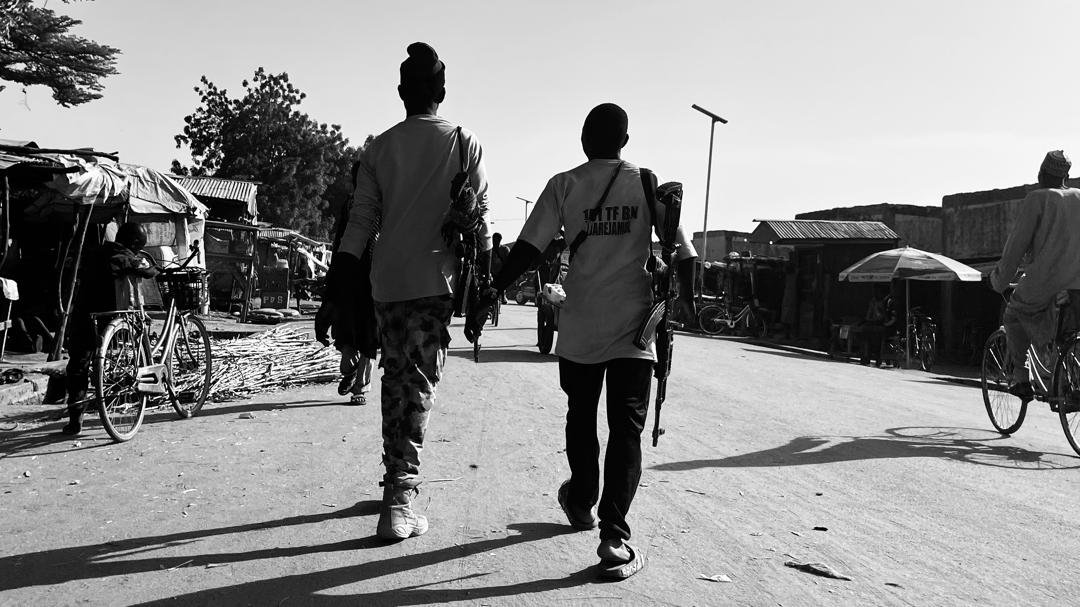
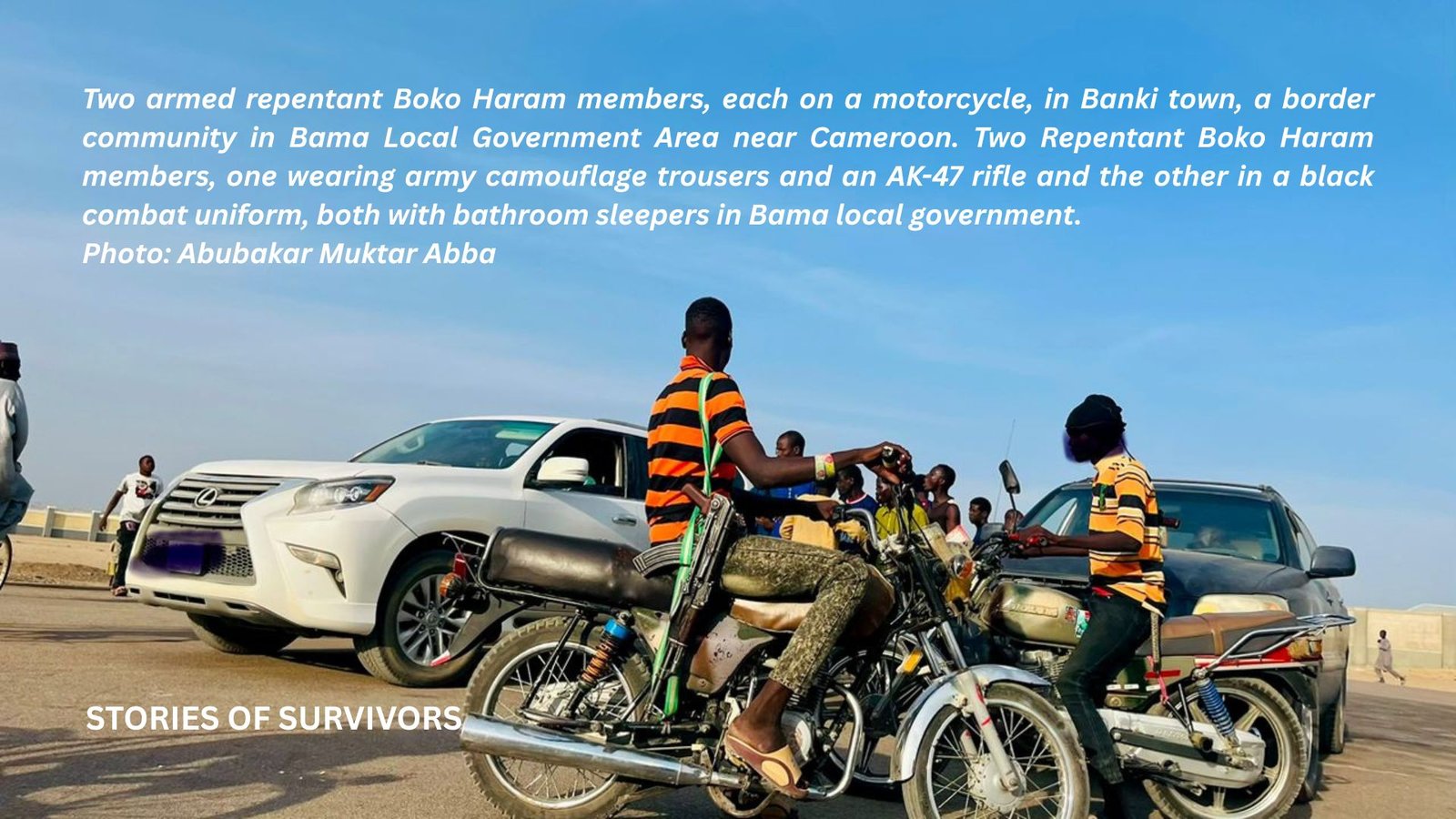
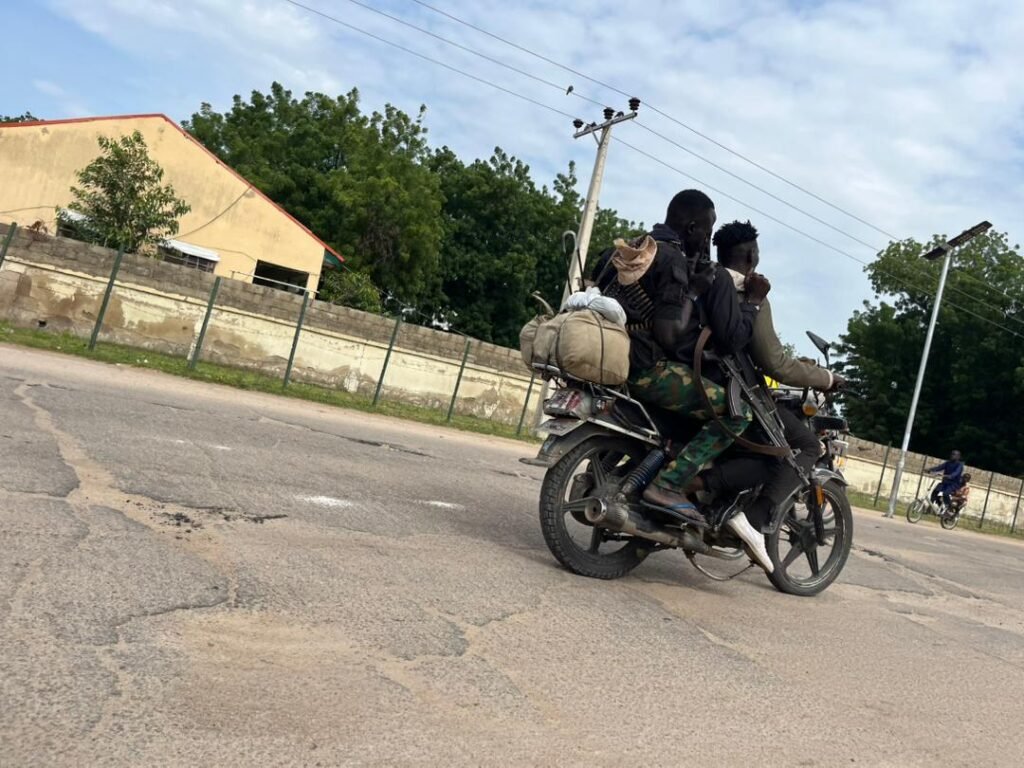
“Every day I step outside, I see repentant Boko Haram members riding through town with guns and motorcycles,” Hajja Bintu said. “It reminds me of how they forced us out of our village in 2014. Sometimes it feels like we are waiting for it to happen all over again.”
Hajja Bintu lived in Gwoza before Boko Haram took over the town in 2014. She was displaced to Adamawa and now lives in the Jere Local Government Area of Borno State.
Although the military has repeatedly denied that it has recruited repentant terrorists to fight in its ranks, residents say that is not the case. Many said they see former Boko Haram fighters now fighting alongside the military.
Their major concern, though, is that these former fighters bring their arms into civilian neighbourhoods.
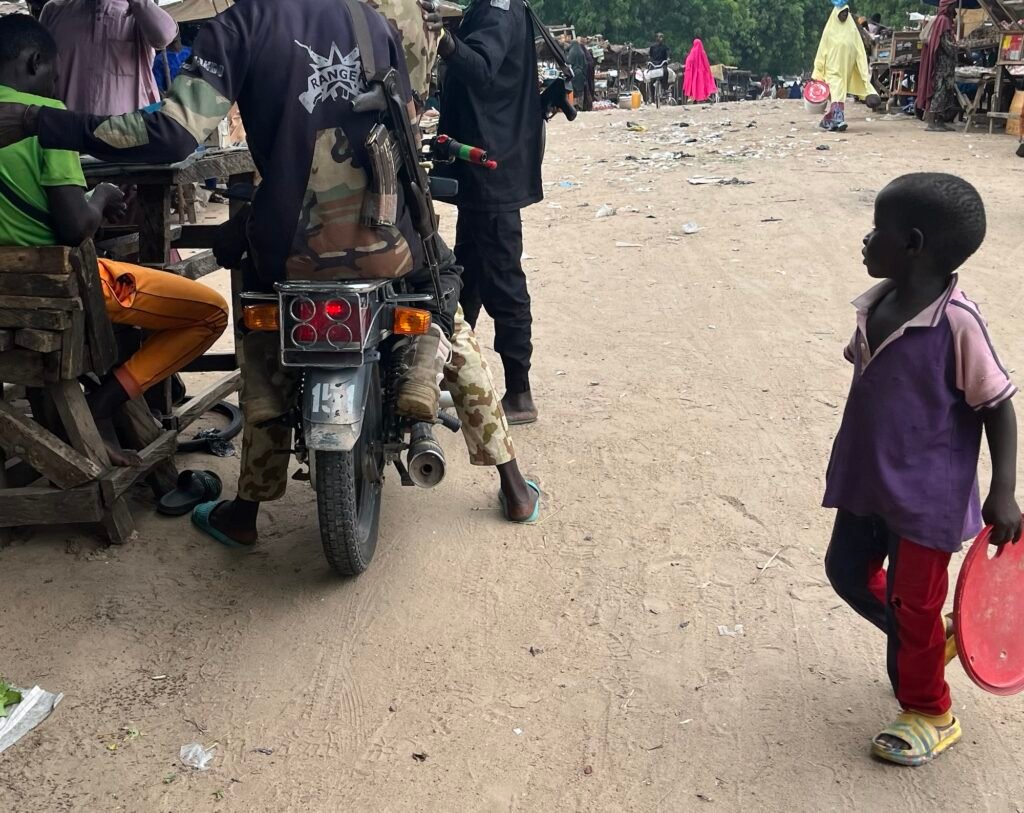
Residents insist that former fighters who now assist the military should not be allowed to carry firearms within civilian neighbourhoods. If they are truly under state control, they say, their weapons should be surrendered upon entering towns.
“Some fire their guns whenever they wish, and nobody dares to speak out. They do what even the military would not do,” Shatu Ali said.
Not all returnees fit that description. Several former fighters say they avoid weapons entirely, wary of being associated with further violence. Yet surviving as civilians has proven far more difficult than they expected.
Abba Ali’s experience reveals the fragility of the reintegration process. Abba Ali was abducted in 2015 when the military recaptured Bama from Boko Haram. He was six years old at the time. He was there when Shekau detonated himself.
Abba was trained as a fighter and remained under Shekau’s command until he was 12.
“We were told there would be help, but nothing came,” he said. “Sometimes, when I am hungry, I think about going back. I just wish I had something to do.”
Unlike some former insurgents who pass through structured deradicalisation programmes, Abba received no vocational training, no counselling, and no psychological support. He was simply released back into the community and left to fend for himself.
In many cases, the social and economic conditions into which former fighters return offer little chance of stability. Jobs are scarce, support networks are weak, and long-term counselling or monitoring is often absent. Without these safeguards, rebuilding a civilian life becomes difficult, and the risk of relapse into violence remains real.
Shettima Habib decided to surrender after hearing a radio broadcast urging members of Boko Haram to lay down their arms. The announcement prompted him to leave Njimiyya village in Bama town and present himself to security authorities, ending his time with the insurgent group.
Yet the transition back to civilian life brought its own difficulties. In his community, employment opportunities were limited, and mistrust toward former fighters remained strong. Struggling to find work and unable to overcome the stigma attached to his past, Habib eventually left Borno State for Lagos, hoping to rebuild his life in Nigeria’s commercial hub.
The programme provides a one-off payment of ₦100,000 (about US$67) after deradicalisation, but this isn’t enough to restart a life after years in the bush.
Research shows that reintegration of repentant fighters often fails due to community mistrust, doubts about their sincerity, fear of espionage, and weak institutional support, leaving returnees socially isolated and struggling to rebuild their lives.
Other defectors faced even harsher experiences. In 2022, Alhaji Gana was abducted from Gwoza local government. After a year in captivity, Alhaji Gana and a few others were forced to join Boko Haram. They eventually escaped two years later. Upon returning to Maiduguri, their reintegration was minimal: they were gathered in a mosque, preached to about fearing Allah and obeying state law, promised start-up capital, and then simply told to return home, without structured support, vocational training, or follow-up.
Disarmed and Rearmed
For many residents in Bama, the reintegration of former fighters is not considered progress but a daily confrontation with memory. Their presence in markets, on streets and at community gatherings serves as a stark reminder of years marked by violence.
“They are seen everywhere,” said Baba Kura, whose parents were killed in an attack by Boko Haram in the town. “Whenever I see them, I remember my parents. I have never trusted them.”
Residents say this distrust is heightened by what they describe as incomplete disarmament. Across parts of Borno State, community members report seeing former fighters dressed in civilian clothing yet still in possession of weapons. While authorities have not confirmed such claims, the perception alone has fuelled anxiety.
In Maiduguri, some locals said former combatants have begun to occupy informal positions of influence, mediating disputes and shaping local decisions. “If you get into a dispute, just involve a repentant, and you can resolve it more easily,” said Isah Brah, reflecting a view that ex-fighters can act as power brokers within fragile communities.
For survivors, these developments complicate an already delicate process of reconciliation, raising questions about oversight, security guarantees and the long-term impact of reintegration efforts.
In Biu local government, an Islamic cleric, Sheikh Abubakar Mustapha, expressed concerns about repentant Boko Haram members moving freely in communities while still armed. While he acknowledged that some returnees had provided valuable intelligence and support to security operations, he cautioned that allowing them to settle among civilians posed significant risks.
“They know everything about us,” Sheikh Abubakar Mustapha said. “This is a real security issue. It would be safer if they remained in the forest than walking among the people with arms.”
He stressed that armed former insurgents have no place in civilian neighbourhoods. “They should be in the bush with their guns,” he added. “People are afraid of them, even if they cannot say it openly.”
Locals say the sight of repentant fighters carrying weapons openly has deepened anxiety in Maiduguri. Residents complain that it is increasingly difficult to distinguish between security personnel and former insurgents, creating confusion and fear. Many argue that weapons should be restricted to authorised operations to prevent further erosion of public trust.
The consequences of this unchecked display of arms are already visible.
On February 21, 2026, at about 5:00 a.m., two armed men wearing army trousers robbed a provision store in Maiduguri. According to the store owner, the men initially posed as customers, requesting goods before pulling out a gun. They made away with two mobile phones and a gas cylinder.
Residents said they believe the two men are repentant Boko Haram fighters who now fight alongside the army.
Repentant members of Boko Haram who now operate alongside the military are sometimes seen wearing elements of army clothing, though not the full uniform. Residents say some wear only army trousers, boots, shirts, or caps, making it difficult to clearly distinguish them from regular soldiers.
However, many civilians say this worries them.
“They (the repentant fighters) always tell us to be careful,” one resident said. “They often say even soldiers cannot do anything to them.”
The fear is rarely voiced publicly. Even when former fighters commit wrongdoing, nobody challenges them. One resident recounted an incident in Konduga in which a repentant fighter killed a young man he saw talking to his girlfriend. A week later, the same man returned to the community without consequence. Other residents said he openly boasted about the authority they once wielded.
Such intimidation, residents claim, has become routine. Many acknowledge that the situation lies beyond their control. Baba Kura, who lost both parents in a Boko Haram attack in Bama, spoke with visible anger.
“They killed our parents and relatives. They drove us from our homes. They destroyed everything. Now we must live with them and watch them move around with guns, just like when they first took over our community.”
Concerned about the fragile balance between reconciliation and public safety, Barrister Zannah Bukar Mustapha, a Maiduguri-based lawyer and mediator, warned that reintegration cannot come at the expense of security.
“Reintegration is important, but it must not come at the expense of security,” he said. “When former combatants are resettled without structured monitoring, clear disarmament protocols, and economic stability, it creates fear within the community.”
He emphasised that the visible presence of firearms in civilian areas undermines public confidence. “If individuals move freely with guns in residential neighbourhoods, citizens will naturally feel threatened. The state must clearly define who is authorised to carry arms and under what conditions. Even soldiers operate within strict command structures.”
Mustapha added that reintegration cannot focus solely on returnees. “Victims also need structured support. Communities require dialogue, trauma healing, and assurances that justice and accountability are not being ignored. Without this balance, resentment will grow.”
He warned that long-term peace hinges on restoring trust between returnees and host communities. “If people feel their concerns are dismissed, the programme risks undermining the very stability it seeks to build.”
Across farming communities in Borno, suspicion has deepened. Farmers describe kidnappers who appear to possess intimate knowledge of their private lives. They sometimes recount details about their homes, livestock, savings, and estimated earnings.
Victims suspect that informants within their own communities are supplying this intelligence. One farmer noted that abductors often dress like the repentant fighters living among them, making it increasingly difficult to distinguish former fighters from active criminals.
Yet the reintegration crisis is not one-sided. For many repentant fighters, the transition has been equally destabilising. Some now fight alongside the military, largely because combat is the only life they have ever known. Several said they accepted to fight not out of renewed ideology but out of familiarity. Civilian life, by contrast, demands skills they don’t possess.
“The law in the bush is different from the law here,” one former fighter explained, highlighting the dissonance between a life shaped by violence and the challenges of reintegrating into everyday society.
Some former fighters said they had more consistent access to food and basic provisions while with Boko Haram than they do now as normal citizens, struggling to survive without stable employment, social acceptance, or long-term support.
Aliyu Isah, 28, who surrendered in 2022 and now assists the military in operations, described his own precarious situation. Like others in his position, he receives only a small allowance, 75,000 Naira, which he says is insufficient to support his family. While fighting in the Sambisa Forest alongside the military, he was shot in the thigh— an injury that ended his combat role and, with it, the modest payments he had relied upon.
“The only thing I know is fighting,” he admitted. “When I could not fight again, the payment stopped. I do not have any skills. I cut firewood and depend on relatives to feed my family.”
Some names have been changed to protect identities.
This report was commissioned with support from the Centre for Journalism Innovation and Development (CJID) under a journalism support initiative funded by the Royal Norwegian Embassy.