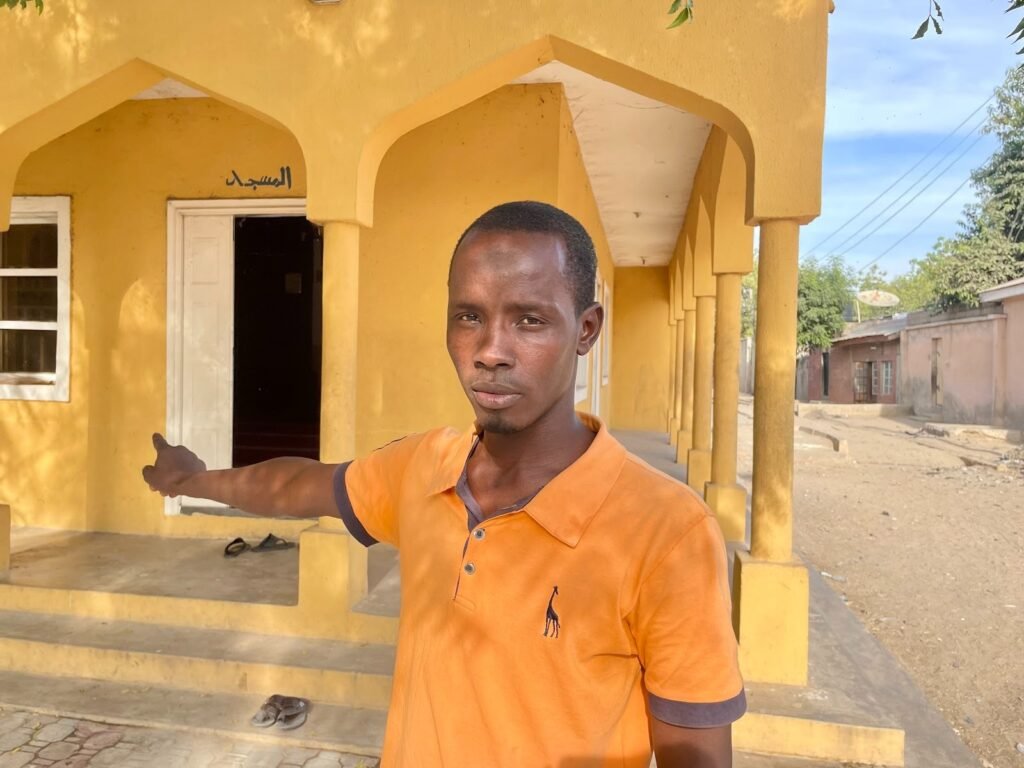

Through Kyari’s eyes, we see how religious indoctrination, absent governance, and systemic neglect in northeastern Nigeria created fertile ground for radicalisation.
For Abba Kyari, it began 22 years ago in 2003.
It was one of those familiar evenings in Maiduguri, Borno, northeast Nigeria, when neighbourhood children spilt into the streets after school, kicking around makeshift balls stitched from old socks, rolling car tyres, skipping rope, and playing many other indigenous games. Those evenings carried a kind of innocence Kyari always looked forward to.
The small joys of childhood defined those moments. After school, he longed to join the other boys outside. But everything began to change when his best friend and neighbour, Ahmad Bukar, 9, started showing up in a crisp white Kaftan and kufi cap. Ahmad had already dropped out of school under the influence of his brother, and his new appearance was the first sign that something in their circle was shifting. Kyari remembers thinking, “I always admired his clean outfits and kufi caps.”
The carefree evenings slowly transformed into something else. Ahmad began gathering the boys after dusk, no longer as a playmate but as a messenger of the lessons he had absorbed at Markaz Yusuf [the mosque where Mohammad Yusuf, the founder of Boko Haram, preached the ideology of Boko Haram], where Mohammed Yusuf delivered sermons that shaped the early ideology of Boko Haram. Sitting in his kaftan and kufi, Ahmad repeated lessons he never understood, warnings about Western schools and divine punishment.
This was the first time Kyari sensed that the world around him was changing in ways he could not yet name, a slow drift that many families across Maiduguri were experiencing at the same time.
But Ahmad was not the only voice pushing that message. “I went to primary school in the morning and attended Islamic school in the evening,” Kyari recalled. “All the boys in my Qur’anic class were Almajirai [Plural for students studying the Quran, mostly children from remote villages]. Every day, they told me I was headed for hell because I went to a formal school. One of the Mallams at a tsangaya I attended wasn’t teaching me anything; he didn’t even flog me like the other students when I failed to read. He ignored me because I went to school.”
The belief that attending a Western school meant joining the school of disbelievers is very common across northern Nigeria. Some families even took pride in a history of avoiding formal schooling.
In Borno state, the Kanuri tribe, the dominant tribe in Borno state, used to say, “If you go to a community and don’t find any disbeliever, a person who went to formal school is one.”
In 2003, Kyari’s Qur’an teacher from a nearby mosque left to fight for the Taliban, reportedly at the Limankara mountain. Around the same time, a self-styled Taliban group hiding in the Gwoza hills and Madara mountains raided a police station, killing officers and stealing ammunition.
These events, happening so close to home, deepened the confusion of children like Kyari who watched respected adults disappear into armed movements without explanation.
In July 2009, when the Boko Haram insurgency erupted in Maiduguri, Kyari was not surprised to learn that Ahmad had joined the first attack carried out in Borno state.
The Pull of Yusuf’s Message
Around 2008 to early 2009, Kyari began visiting Markaz Yusuf with other boys from their tsangaya. “I was even at the Markaz the last Friday before the July attack,” Kyari said.
It became a trend to attend Yusuf’s sermons. Even though they remained outside, they were drawn by the uproar of people inside shouting, “Allahu Akbar” [God is Great] Kyari said, “But one of the things that captivated me the most is how we children were welcomed without any difference.”
Reflecting on those days, Kyari said, “I am afraid that if Yusuf’s teaching had lingered a little longer, a great number of the Muslim community in Borno State would have followed him.”
Kyari remembers his grandmother recounting the long-standing resistance to formal education in their community in what is now Damaturu, Yobe State — an ideology that predated Mohammed Yusuf. She recalled in the 1950s that when she finished primary school, a neighbour told her that getting the certificate was like obtaining a pass to hell.
She only attended school because the colonial administration mandated community heads to enrol their children.
A woman once convinced her father not to allow any of his children to collect their Primary school certificate. “The woman convinced my father that collecting the certificate is evidence of the sins of attending school,” Kyari’s mother remembers from her mother’s memory.
Her only daughter — Kyari’s mother — was never enrolled, and her first daughter, Kyari’s sister, dropped out after completing secondary school to marry.
For Mohammed Yusuf, these ingrained ideologies made his message more potent because Boko Haram grew from a soil that already held the seeds of distrust toward secular education.
A Region Already Drifting
Northern Nigeria is home to millions of out-of-school children. UNICEF estimated that over 81% of the 10 million out-of-school children in northern Nigeria were outside formal schooling, many in the Almajiri system, living away from home and surviving by begging.
Usman Abba Zanna, a humanitarian journalist in the Lake Chad region, describes this as a “pre-radicalisation environment,” where emotional vulnerability and a search for belonging created fertile ground for recruitment.
“The real recruitment didn’t begin with guns. It began with the erosion of a child’s sense of direction. There is an existential lack of social accountability in society,” he explained.
“Once you convince a boy that his future lies only in a narrow ideology, you’ve already done half the work for the insurgency.”
“Young minds are more susceptible to radical ideas because it’s a slate that is open to any form of information. This is the battle of the mind that needs strong social, political, economic and environmental support because they are powerful pillars.”
What Kyari lived through was not an isolated childhood crisis but part of a much wider collapse in the structures that should have protected young people.
Boko Haram rarely needed to coerce loyalty. Many recruits had already absorbed for years the idea that modern education was poisonous to their faith and identity. The insurgency merely formalised what had long been circulating.
Where government presence was nearly non-existent, Boko Haram became the only authority communities knew. Some villages had no schools, no hospitals, sometimes not even water. The state was absent. Yusuf became, to them, a figure of rescue.
The Birth of Boko Haram
Nigeria’s transition from military rule to democracy in 1999 was turbulent. The country had endured decades of violent military dictatorships marked by coups, repression and entrenched corruption. Rural and peripheral communities suffered the worst neglect.
In Maiduguri, on the northeastern fringe, the teachings of Ibn Taymiyyah — a medieval Sunni scholar— found new traction. His writings argued that corrupt rulers could be legitimately opposed. These ideas resonated with young people shaped by years of state failure.
Among them was Mohammed Yusuf, a fiery preacher who founded the Ibn Taymiyyah Masjid, gathering around him a group of like-minded followers. That nucleus evolved into the early Boko Haram movement.
Abubakar Shekau, who studied at the mosque, shared the deep anger of his peers. His sermons trembled with fury as he condemned state injustice. Yusuf and Shekau’s words reached hundreds of youths who felt unseen by the state. Their message of purity and justice — however distorted — offered dignity.
Yusuf preached in Hausa and Arabic, drawing young men from overcrowded tsangaya schools and communities where formal schooling offered little hope. Markaz Yusuf soon became a magnet for frustrated young people searching for meaning.
By the mid-2000s, friction between Yusuf’s followers and security forces intensified. Police labelled them radicals. The group saw security agencies as agents of a failed state. The confrontation reached a breaking point in 2009, spreading through Maiduguri and neighbouring towns, leaving hundreds dead. Yusuf was captured and later died in police custody, a turning point that hardened the group.
Shekau then reorganised Boko Haram into a more violent insurgency. Bombings, assassinations and mass abductions followed. By 2014, the world was stunned when Boko Haram kidnapped more than 270 girls from Chibok, exposing the region’s deep educational crisis.
Economic Enslavement
Mohammed Yusuf gained popularity among students and young professionals seeking a deeper understanding of Islamic knowledge. He empowered hundreds by providing the means to earn a living while following his teachings. He procured taxis, buses, and motorcycles for the youths, who then remitted a portion of their earnings to him.
“That singular gesture of youth empowerment endeared hundreds to him. Even after his death, the beneficiaries have endless respect for him because they believe he impacted them both economically and religiously.”
The Risk of the Cycle Repeating
The structural conditions that enabled radicalisation remain largely unchanged. School attendance across the northeast is still among the lowest in Nigeria. Thousands of children roam the streets without structured learning, battling hunger, boredom and trauma.
Recent fieldwork in the Bama IDP camp by Stories of Survivors revealed a troubling mindset among youth. Many did not reject Boko Haram’s ideology entirely. They opposed random killings and resented displacement, but said that if Boko Haram allowed them to farm and remain in their villages, they would accept the group’s Islamic laws and punishments.
Traditional Quranic education still holds spiritual knowledge above secular learning. Some clerics denounce Western curricula as corrupted. Reformist Izala imams have warned that Western schools are immoral and polluting. Even prominent Muslim leaders have cautioned followers that Western education undermines their culture. Such views saturate the Almajiri environment.
A rhyme commonly heard among Almajirai casts their peers in secular schools as irreligious and disrespectful, reinforcing distrust toward formal education.
Barrister Zannah Bukar Mustapha, a mediator and humanitarian actor who founded the Future Prowess Islamic Foundation, said the forces that once pushed Boko Haram to this level are still active.
He pointed to the economic strain caused by the shrinking Lake Chad region and the long-standing governmental neglect in providing education. He cited the example of how the whole of northern Borno, which comprises ten local governments, has not had a single tertiary institution.
He further explained that some local governments, such as Guzamala and Kala Balge, have never had a secondary school. “What will they do after primary school?” he asked. “These are the things that contributed.”
He added that radicalisation is rarely just about ideology; it is often a symptom of systemic failure. ‘When young people cannot see a future, they become highly susceptible to groups that promise purpose, structure, and income,’ he said.
Zannah also highlighted the importance of early intervention. “Programs targeting children before they leave school or are forced into the streets are crucial. Skills development, mentorship, and community support can break cycles of extremism,” he explained.
To address this, he advised the government to consider specialised schooling that combines essential education with skills that can guarantee financial independence.